
The no-guilt guide to a
Profitable Private-Pay Practice
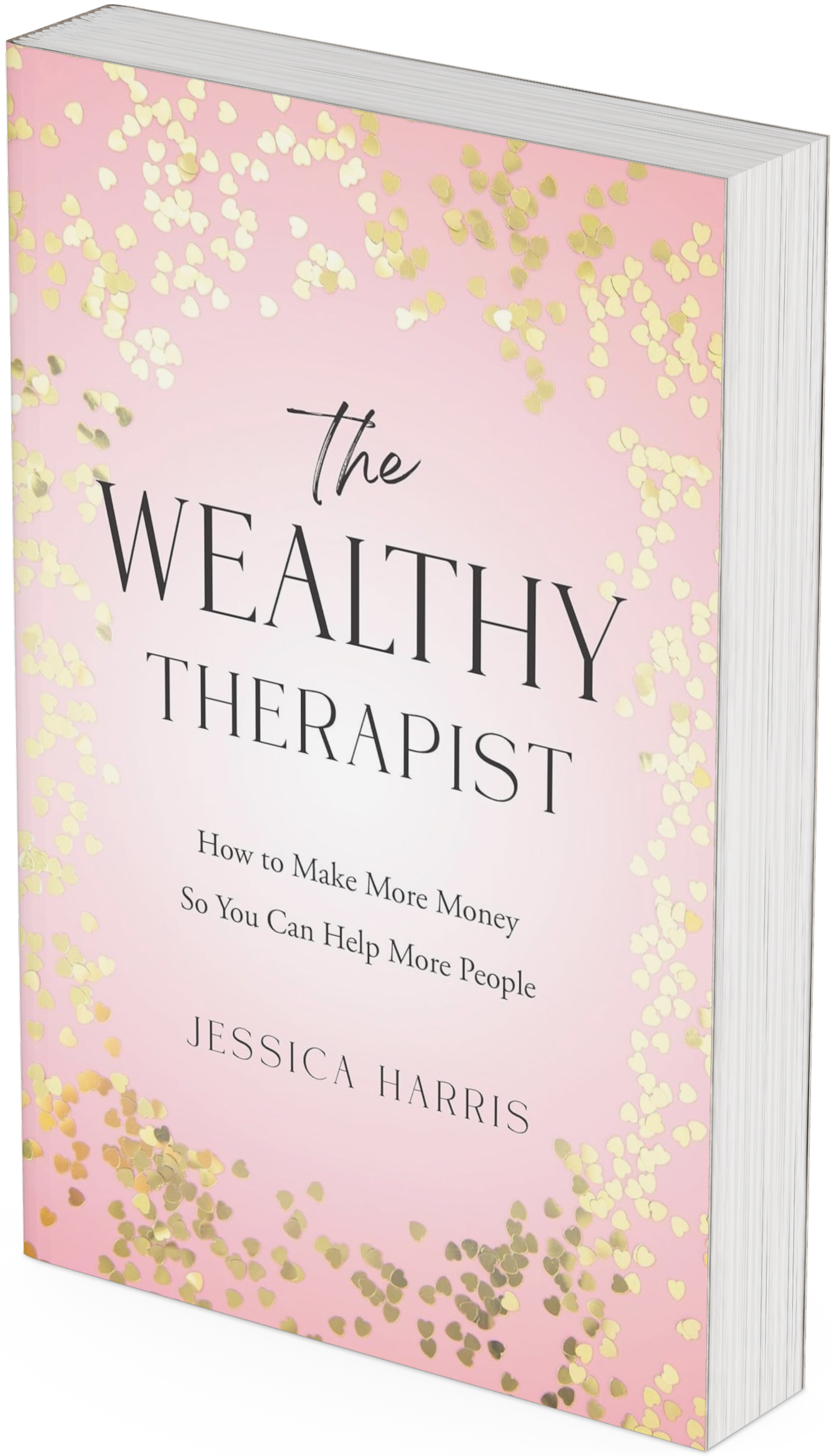
The Wealthy Therapist is a book by Jessica Harris, for therapists who want to build a profitable private-pay practice without burning out. It covers moving off insurance panels, simplifying marketing, setting rates you can hold, and building income beyond the one-to-one therapy hour.
Available in Paperback.
Published December 16, 2025. 148 pages.
We learn how to help everyone but ourselves
This book fixes that
WHY DID JESSICA HARRIS WRITE THE WEALTHY THERAPIST?
Jessica Harris wrote The Wealthy Therapist because she kept meeting the same therapist: skilled, deeply committed, exhausted, underpaid, and quietly wondering whether the career was survivable. The book is the business education that clinical training leaves out.
I kept seeing the same pattern. Talented, caring therapists who were burnt out and broke and starting to think the problem was them.
It isn't them. We're taught how to help other people and we're not taught how to build something that supports us in return. Six years of school, hundreds of supervised hours, and not one class on how the money works.
This book is my answer to that gap. It's a practical roadmap for moving into private pay, simplifying your marketing so it stops eating your evenings, expanding past the one-to-one hour, and building a practice that leaves room for a life.
This book is my answer to that gap. It's a practical roadmap for moving into private pay, simplifying your marketing so it stops eating your evenings, expanding past the one-to-one hour, and building a practice that leaves room for a life.
The ideas in it are the foundation of everything I do now.
I also wrote it because of the guilt. Every therapist I know carries some version of it: the sense that charging well is slightly at odds with why we got into this, that a colleague who takes insurance is doing something more honorable, that wanting a good income makes you less serious about the work. I carried it for years and it cost me real money and, more to the point, it nearly cost me the career.
So the book says the quiet part plainly. A therapist who cannot pay her bills leaves the field. A therapist who is exhausted is a worse clinician than a therapist who is rested. Your rate is not separate from your clinical work. It is the thing that determines how long you get to keep doing it.
That's the no-guilt part of the subtitle, and it isn't a marketing line. It's the argument.
WHAT IS THE WEALTHY THERAPIST ABOUT?
The Wealthy Therapist covers four things: the real economics of insurance versus private pay, how private-pay clients actually find a therapist, how to set and hold a rate that sustains you, and how to build income that doesn't require another hour in the chair.
THE MONEY CONVERSATION NOBODY HAD WITH YOU
What insurance actually pays, when it pays, and what it costs you over a career.
BEYOND THE THERAPY
HOUR
Intensives, group work, and other income that doesn't require you to clone yourself.
HOW CLIENTS FIND
THERAPISTS
Where people actually look, and why being good at your job isn’t the same as being findable.
BUILDING SOMETHING
THAT LASTS
Hiring, systems, and what changes when the practice isn't only you.
SETTING A RATE YOU CAN SAY
OUT LOUD
Pricing without apology, and what to do when someone pushes back.
It is a short book on purpose. You are tired, and a 400-page business to me is not going to get read by someone who has already given the day away. Every chapter ends with something you can act on that week, and nothing in it requires you to buy a second thing to make the first thing work.
Read it if you're on panels and doing the math.
The book lays out what insurance actually pays, when it pays, and what that looks like across a career, so you can decide with numbers instead of nerves.
Read it if you went private pay and it's quiet.
The silence usually means a visibility problem, not a demand problem. The book explains the difference and what to do about it.
Read it if you're about to open a practice.
Setting your rate correctly at the start is far easier than raising it on forty existing clients later.
Read it if you're full and still not making enough.
A full caseload at the wrong rate is a treadmill, and there's a chapter on getting off it.
It is not a book about becoming a coach, and it is not a book about leaving clinical work. It's for therapists who want to stay therapists and want that to be financially survivable.
Real Reviews from Real Therapists.
IS THE WEALTHY THERAPIST WORTH READING?
Therapists who have read The Wealthy Therapist describe it as practical rather than motivational, and specific enough to act on. Here is what they've said.
⭑⭑⭑⭑⭑
"This book will change your life."
"If you've been lost as a private practice owner, googling everything you can to try to figure out how to be successful, or even get started, then this book is for you. I've been that therapist and I've gone through Jessica's program, and I can confidently say it was the best decision of my life. This method doesn't just offer incredible tools and a transformative mindset shift, it gives you the freedom you've always wanted."
-Selena Vigue, MFTC
⭑⭑⭑⭑⭑
"Learn how to get paid your worth while helping so many."
"I have personally worked with Jessica and she is absolutely amazing. If you are a therapist and tired of being overworked, underpaid, and dream of more while still helping others, I highly recommend this book and working with Jessica. She changed not only my practice, but me personally as well."
-Kim
⭑⭑⭑⭑⭑
“A powerful read that strengthened my belief.”
“Jessica Harris is brilliant, and this book makes that undeniable. I'm currently in her program, and reading the book alongside it has grounded me in belief like, yes, this is possible for me. I love how she shares her humble beginnings and still delivers so much insight, strategy, and truth. Easily one of my favorite books."
-Olivia
The book shows you what's broken.
The Accelerator fixes it with you in the room.

Read the book if you want to understand the problem and decide for yourself whether the answer makes sense. It's the cheapest way to find out if we think the same way.
Join the Accelerator when you want someone telling you what to do this week and checking whether you did it. Most therapists don't need more information. They need sequence, deadlines, and a person who has already done it looking at their specific practice.
There is no trick here and no upsell buried in chapter nine. The book is a real book and it stands on its own. Plenty of therapists read it, do the work themselves, and never talk to me, which is a completely good outcome and the reason I wrote it down instead of keeping it as a program.
The people who join the Accelerator are usually the ones who read it, agreed with it, tried it alone for a few months, and decided they'd rather have company and a deadline. That's not a failure of the book.
That's most of us.